
Defining evangelicalism
A historiographical interlude

As my historian friends know, there are few things I enjoy more than discussing historiography. That’s why I love academic conferences. I love the sessions themselves, and even more than that I love staying up to the wee hours of the morning at nondescript hotel bars debating the finer points of historical interpretation.
Recently, I was alerted to a paper that published in the Journal of the American Academy of Religion on the historiography of American evangelicalism that discusses Jesus and John Wayne. I was told that it faults the book for not considering British evangelicalism in my discussion of American evangelicalism.
This critique intrigued me.
My first book, A New Gospel for Women, examines transatlantic evangelicalism and late-nineteenth-century evangelical social reform, with a focus on the influence of British evangelical reformer Josephine Butler and her influence on the American reformer and feminist theologian Katherine Bushnell.
When writing Jesus and John Wayne, I initially included a section in the first chapter in the import of nineteenth-century British muscular Christianity, but sadly ended up cutting it due to word count.
My next book, Live Laugh Love, spends considerable time exploring late-nineteenth and early-twentieth century Anglo-American connections with particular focus on Keswick holiness networks.
Which is to say, when I write on American evangelicalism, I do not do so oblivious to British and global connections.
I was, then, curious to read the article in question: Thomas E. I. Whittaker’s “British Evangelicalism and the Making and Remaking of American Evangelical Identity.” Here’s the abstract:
This article engages with an ongoing controversy over the coherence of evangelicalism, that is, the question of whether the term corresponds to a coherent movement stretching from the eighteenth century to the present or is a false throughline constructed by modern evangelical historians. This American-focused scholarship has a major lacuna: its failure to reckon with evangelical Christianity outside of the United States. Evangelical Christianity has always been more cogent in Britain than the United States, in large part because of the minority status and unusual institutional cohesion of the evangelical wing of the Church of England since the end of the eighteenth century. In the mid-nineteenth century and again in the mid-twentieth century, British evangelicalism played a major role in clarifying what it meant to be “evangelical” in the United States. The “evangelical throughline” stretches across the Atlantic. Evangelicalism is neither a twentieth-century invention nor fundamentally American.
Whittaker is responding in part to Matt Sutton’s 2024 article in the same journal, in which Sutton rejects any “multi-century evangelical throughline” from the purported “evangelicalism” of Jonathan Edwards to the “evangelicalism” of Billy Graham. Sutton’s argument has generated considerable debate within the field—a healthy debate, in my opinion.
Then, my name pops up: “Prominent scholars such as Kristin Kobes Du Mez (2020) and Anthea Butler (2021) urge a shift from a “theological” definition of evangelicalism to a “political one.”
The problem with this is that I don’t.
I looked to his citation to see what he was basing this verdict on, and it’s not my book, or any of my writings. It’s a 2023 book on British and Canadian evangelicals that I haven’t read, so I can’t attest to its accuracy or framing. I read on, assuming Whittaker would be bringing more evidence in defense of his assertion. We were, after all, only on page two.
The rest of the article contains much more on Sutton and on a couple dozen other works in the field, but there is no mention of me or Jesus and John Wayne until the conclusion. Here, too, it’s an assertion without documentation:
“A focus on the international dimension of evangelicalism has been shockingly absent amid the efforts to redefine American evangelicalism away from Bebbington’s classic emphases….Scholars like Kristin Kobes Du Mez and Matthew Avery Sutton instead prioritize right-wing politics, free-market economics, Christian nationalism, misogyny, and racism and deny any continuity with a period before fundamentalism.”
The claim that I deny any continuity with a period before fundamentalism is a stunning mischaracterization of the entire body of my scholarship.
That said, as a scholar focusing on gender and politics in modern America, I’ll concede to “prioritizing” the above list of things in the book that I wrote on the topic of white evangelical masculinity and militarism. But, I do not define evangelicalism exclusively in those terms. Here I part ways with scholars like Sutton, who wade more boldly into such definitional waters. (More on that in a bit.)
Whittaker goes on:
“Du Mez repudiates Bebbington’s “theological” definition in favor of these “political” emphases but with only limited comment on the global nature of evangelical Protestantism. Du Mez concedes that, defined theologically and internationally, ‘‘evangelicalism’ manifests as a racially diverse and global movement’ (Du Mez 2020, 5). But otherwise, Du Mez’s Jesus and John Wayne ignores the issue in order to adopt a political definition of the movement. Like Sutton, her only mention of Britain is in the title of Bebbington’s book. The world beyond the United States manifests in geopolitics but rarely in global missions.”
So, the one direct quote from JJW in the article is one he explains away to insist that in fact I “adopt a political definition of the movement,” without, once again, providing evidence.
I do not in fact define evangelicalism politically. Truth be told, I am uninterested in offering a timeless definition of evangelicalism. I think that project is a faulty one.
Instead, I am intent on describing a movement that changes over time, one with roots in the past, yes, even if I do not embrace a direct “throughline.”
Whittaker may not be aware, but I have written and spoken extensively on “the definitional question” of evangelicalism. For example:
Debates over who is and isn’t an evangelical have become commonplace among scholars. Some of these debates have played out here at the Anxious Bench. Should evangelicalism be a theological category, à la David Bebbington? If so, people of color deserve a prominent place within evangelicalism. Or, is “evangelicalism” a cultural movement—one defined by its whiteness and its politics as much as (if not more than) by any particular statements of belief? Should we think of evangelicalism first and foremost as a global movement? As one represented by such luminaries as John Wesley, Jonathan Edwards, and William Wilberforce? Or as the politicized, white, God-and-country movement best represented by Robert Jeffress and the Duck Dynasty clan?
What if the answer is all of the above?
For scholars, perhaps the time has come to set aside our quibbling over definitive rubrics and our attempts to dictate, once and for all, who is and who is not an evangelical, and instead begin to consider evangelicalism as an imagined religious community.
There are, in fact, many evangelicalisms, and each is imagined with a different center and different boundaries.
If we consider “evangelicalism” an imagined religious community—imagined as inherently limited, bounded, with insiders and outsiders—we must pay close attention to questions of power. Individuals, communities, theologians, organizations, leaders, and distribution networks all imagine evangelicalism in different ways. (One person may even imagine it in conflicting ways simultaneously, using each for different rhetorical purposes, identifying with or against different imagined constructs.)
A question of power
The primary question, then, isn’t which definition is “correct,” but rather which imaginings have more power to shape other people’s imaginings. When LifeWay decides you are no longer an evangelical, it matters. At least if you want to sell books. When the evangelical left claims the mantle of evangelicalism, it matters rhetorically. Does it matter beyond their own circles? Perhaps. This is a question worth exploring.
This shift in focus demands that scholars, too, examine their own positionality. How have scholars imagined evangelicalism, and to what end? How have their definitions opened up some questions and topics for exploration, and closed down others? Which scholarly imaginings have wielded power in the academy, and why?
Whittaker might be forgiven for missing the many places where I’ve written or spoken about this subject (including national outlets such as Religion News Service, or coverage of a talk I gave at the American Historical Association in The Christian Post.)
But let’s take a closer look at what I do in Jesus and John Wayne.
Whittaker is right to point out that I part ways with the Bebbington definition. As a cultural historian, I think that there’s more to evangelicalism than what can be contained within a theological rubric, and in the introduction to JJW I explain why. I cite studies conducted by evangelicals themselves revealing evangelicals’ theological illiteracy. I also discuss how just 25% of Black Christians who subscribe to all of Bebbington’s “evangelical distinctives” identify as evangelical:
“This is not a simple misunderstanding. Black Christians have long resisted embracing the evangelical label because it is clear to them that there is more to evangelicalism than straightforward statements of belief. Survey data indicate that on nearly every social and political issue, black Protestants apply their faith in ways that run counter to white evangelicalism. The differences may be rooted not just in experience but in the faith itself; in practice, the seemingly neutral “evangelical distinctives” turn out to be culturally and racially specific….” (6).
Then, I move to the heart of my introduction—the part Whittaker ignores entirely:
“White evangelicalism has such an expansive reach in large part because of the culture it has created, the culture that it sells. Over the past half century or so, evangelicals have produced and consumed a vast quantity of religious products: Christian books and magazines, CCM…, Christian radio and television, feature films, ministry conferences, blogs, T-shirts, and home decor. Many evangelicals who would be hard pressed to articulate even the most basic tenets of evangelical theology have nonetheless been immersed in this evangelical popular culture. They’ve raised children with the help of James Dobson’s Focus on the Family radio programs or grown up watching VeggieTales cartoons. They rocked out to Amy Grant or the Newsboys or DC Talk. They learned about purity before they learned about sex, and they have a sliver ring to prove it. They watched The Passion of the Christ, Soul Surfer, or the latest Kirk Cameron film with their youth group. They attended Promise Keepers with guys from church and read Wild at Heart in small groups….The diffusion of evangelical consumer culture extends far beyond the orbit of evangelical churches….Denominational boundaries are easily breached by the flow of religious merchandising. Indeed, one can participate in this religious culture without attending church at all.
Yet this cultural evangelicalism remains intertwined with “establishment evangelicalism.” Denominational organizations and parachurch groups, pastors and theologians, colleges and seminaries, publishing houses and charities generate much of the rligous content that is marketed to an immense congregation of consumers. Evangelical leaders bestow authority upon one another, blurbing each other’s books, defending each other on social media, and determining which up-and-coming writers, pastors, and organizations are worthy of promotion—and which should be shunned….Rather than seeking to distinguish “real” from “supposed” evangelicals, then, it is more useful to think in terms of the degree to which individuals participate in this evangelical culture of consumption (7-8).
To make a long story short, I am not trying to define evangelicalism writ large as a timeless category that extends from the seventeenth century to the present. That is simply not a project that interests me. Rather, as a historian of modern American religion, I’m examining key facets of the movement we call evangelicalism today.
Rather than “defining” evangelicalism, I describe the movement as a consumer culture, and in terms of networks and alliances. Within this movement, there is theological and political diversity. Here’s more from the intro to Jesus and John Wayne:
At any given time, numerous creeds have coexisted and competed for influence within evangelicalism. Even today, the evangelical tent includes Calvinists and Pentecostals, “social justice warriors” and prosperity gospel gurus. However, over the past several decades conservatives have consolidated their power within the broader movement. Offering certainty in times of social change, promising security in the face of global threats, and, perhaps most critically, affirming the righteousness of a white Christian America and, by extension, of white Christian Americans, conservative evangelicals succeeded in winning the hearts and minds of large numbers of American Christians. They achieved this dominance not only by crafting a compelling ideology but also by advancing their agenda through strategic organizations and political alliances, on occasion by way of ruthless displays of power, and, critically, by dominating the production and distribution of Christian consumer culture.
Like evanglicalism in general, evangelical popular culture encompasses a broad spectrum of religious and political commitments. The same store might stock books by conservative financial advisor Dave Ramsey and social justice activist Jim Wallis, Christian feminist manifestos penned by Rachel Held Evans and Sarah Bessey, and classic defenses of “traditional womanhood” by Elisabeth Elliot. Yet the power of conservative white evangelicalism is apparent in both the size of its market share and its influence over religious distribution channels. As a diffuse movement, evanglicalism lacks clear institutional authority structures, but the evangelical marketplace itself helps define who is inside and who is outside the fold….
The products Christians consume shape the faith they inhabit. Today, what it means to be a “conservative evangelical” is as much about culture as it is about theology. This is readily apparent in the heroes they celebrate. Establishment evangelicals might count Jonathan Edwards and George Whitefield among their eminent forbearers, but evangelical popular culture is teeming with a different ensemble of heroes—men like William Wallace (as brought to life by Mel Gibson), Teddy Roosevelt, the mythic American cowboy, Generals Douglas MacArthur and George S. Patton, and the ordinary American soldier. And the actor John Wayne (9-10).
And, finally, the closing paragraph of the intro:
Across two millennia of Christian history—and within the history of evangelicalism itself—there is ample precedent for sexism, racism, xenophobia, violence, and imperial designs. But there are also expressions of the Christian faith—and of evangelical Christianity—that have disrupted the status quo and challenged systems of privilege and power….Contemporary white evangelicalism in America, then, is not the inevitable outworking of ‘biblical literalism,’ nor is it the only possible interpretation of the historic Christian faith….It is, rather, a historical and a cultural movement, forged over time by individuals and organizations with varied motivations—the desire to discern God’s will, to bring order to uncertain times, and for many, to extend their own power (14).
Given my emphasis on networks and alliances in Jesus and John Wayne and elsewhere, it was surprising to see where Whittaker ends up. After faulting “Sutton’s and Du Mez’s interpretive moves,” he suggests instead following the lead of David Hempton:
“we should recognize evangelicalism as an incredibly complex set of transnational networks, nodes, and nuclei whose bounds have been contested over time…A netowrk approach to evangelicalism that takes into consideration shared religious identities…historical trajectories, and the framing work of historians does not necessarily need to replace a theological definition and certainly must take into account the political dimensions raised by Sutton and Du Mez….A network approach helps prevent the kind of provincialism that requires us to arbitrarily define evangelicalism by its contemporary American political affiliations…
I would love for Whittaker to take another look at Jesus and John Wayne—a book I believe Hempton considers largely consistent with his approach based on my own interactions with him—at what it claims to do, and what it does not claim to do.
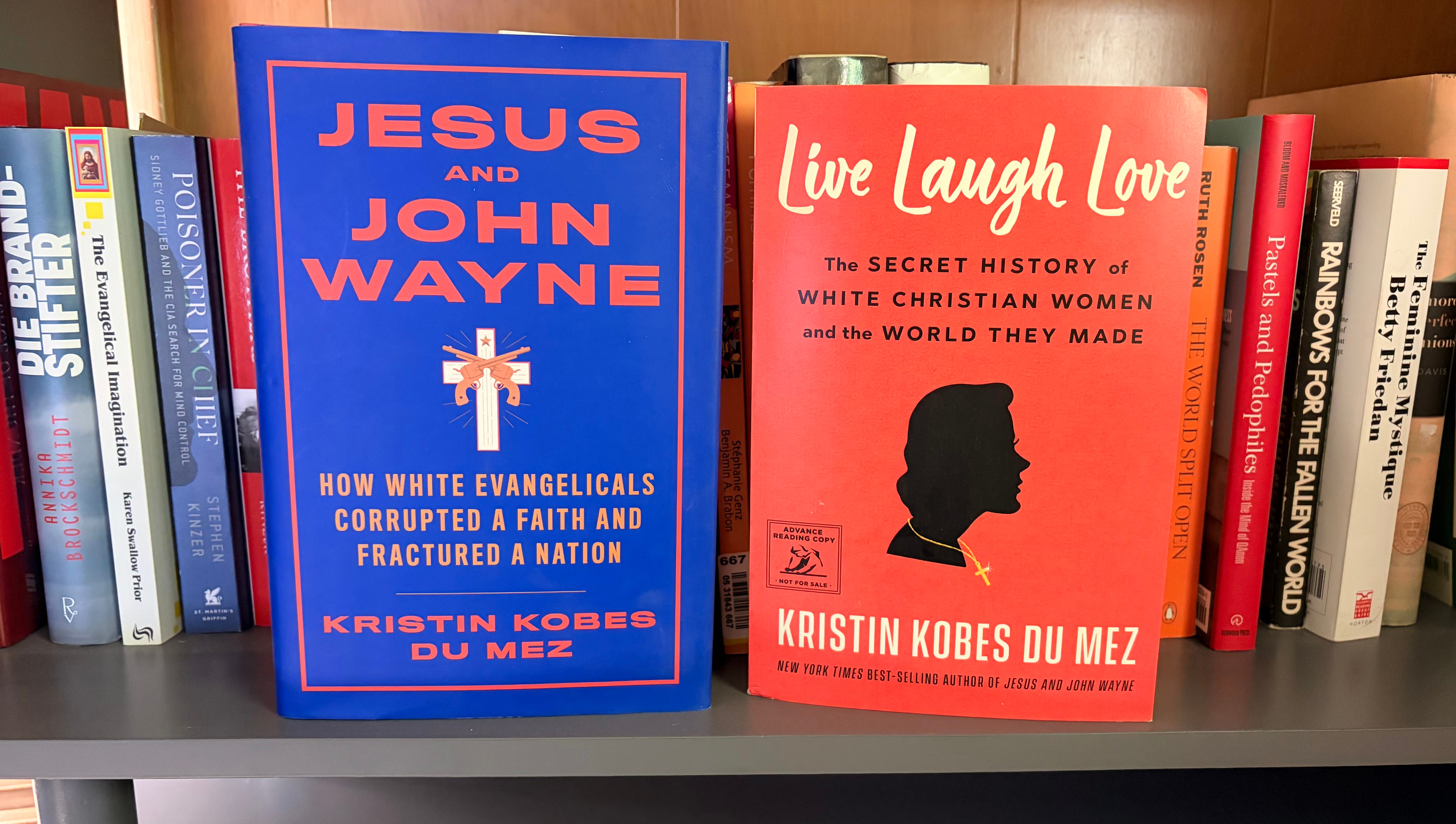
Even more so, I would love for him to pick up Live Laugh Love when it releases this September. It’s not just about mommy blogs and romance novels and Hallmark movies. It’s also about networks and alliances, and because the book starts in the nineteenth century, it has much more on how British and American networks intersected to create the modern American movement. (In identifying and tracing some of these roots, my work differs in some ways from Sutton’s approach. Matt was kind enough to read my entire manuscript and offer his brilliant feedback, some of which included pushing back on exactly this.)
In Live Laugh Love, I trace largely hidden networks through the twentieth century that helped give rise to the cultural world of white Christian (not just evangelical) women, and that profoundly shaped American and global politics.
None of this contradicts the story I tell in Jesus and John Wayne. Rather, the two complement each other, so to speak.
I've no academic background for the scholarly discussion. Found 'Jesus & John Wayne' very informative for your historical observations and insights.
On a related note, may we consider the extent to which the Obama-era Tea Party and/or MAGA "constitutionalism" proceeded from the original ideas of Locke, de Montesquieu, Hobbes, and Rousseau and on through Madison, et al? I expect interviews of participants at a gathering of Tea Party or MAGA believers would mention those philosophical underpinnings... rarely. I think a movement can build itself using (adopting/appropriating?) selected images & slogans without necessarily evolving directly from that prior movement, the symbols of which have been incorporated. Even when a current movement has a clear through line to a predecessor, it's possible that many current joiners do not, themselves, have that in their own history. Therefore the current culture may derive as much from the new joiners' beliefs & desires as from the "old school" underpinnings. Unlike a gradual evolution, the new influx can bring something altogether different into the culture. So in seeking to understand today's MAGA mindset, I wouldn't know that studying up on Locke or Rousseau would help too much
“the two complement each other, so to speak.” 💀 Not only are you a top-notch researcher, but your writing skills… 💯🎯 Nicely done.