
Summer Reads
Any book can be a beach read if you try hard enough

I have a stack of new books on my floor—my summer must-reads. Some are written by friends, some by people I’ve never met. Now that I’m finally at a place where I can start to pick them up, grab a jalapeño limeade, and head out to my hammock chair.
The first is a new book by William Stell—I read portions of the book in manuscript form, but now that it’s published and I have a hard copy, I’m looking forward to reading it cover-to-cover. Born Again Queer: A History of Evangelical Gay Activism and the Making of Antigay Christianity historicizes the antigay movement within evangelicalism—how did it take the shape it did, when, and why? It also brings to light stories of gay rights activists who drew on their Christian faith in their activism.
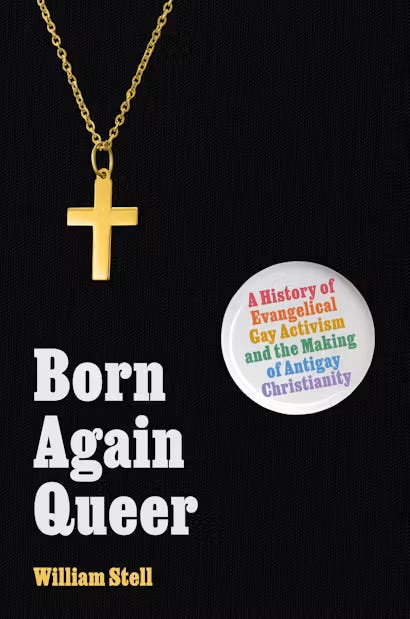
A book on this subject is long overdue, and if you want a sense for what Stell has uncovered, follow him on IG (@william.stell) or check out one of his many podcast interviews or YouTube talks. Here’s a fun one with Ben Park:
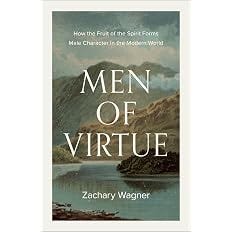
In a slightly different direction, Zachary Wagner has written a book on masculinity for evangelicals—including for conservative evangelicals—one that centers virtue rather than aggression or militancy.
After Jesus and John Wayne published, I’d often have conservative evangelicals ask me to spell out what good Christian manhood looks like. I explained that this wasn’t my primary task as a historian, but not wanting to dodge the question entirely, I suggested that we start with what the Bible says about what evidence of the Holy Spirit looks like in the lives of believers. We have a handy list provided, the “fruit of the Spirit”—things like love, joy, peace, patience, kindness, gentleness, faithfulness, goodness, and self-control. These days, most of these attributes are coded feminine, at least in certain evangelical circles. But I remind people that this list is not given to women or men, but to all who follow Christ.
This is the foundation of Wagner’s Men of Virtue: How the Fruit of the Spirit Forms Male Character in the Modern World. The book would be ideal for churches and book clubs with conservative members or a mix of conservative, moderate, and progressive.
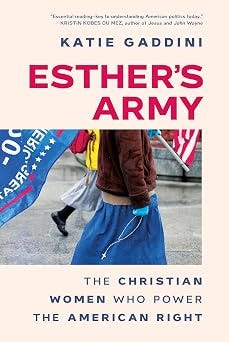
Another brand-new book is Katie Gaddini’s Esther’s Army: The Christian Women who Power the American Right. I cover some of this territory in the last chapter of Live Laugh Love, but Gaddini offers a more detailed portrait of the role conservative Christian women play in the broader MAGA movement. There’s a lot of talk about tradwives and the likes of Erika Kirk these days, but Gaddini’s book goes beyond the headlines to understand why women on the Right see themselves as empowered.
Two other books that dovetail with Live Laugh Love, which I’ll probably write more on down the road, are Kristin T. Lee’s We Mend with Gold: An Immigrant Daughter’s Reckoning with American Christianity, and Lauren Smallcomb’s Golden Child: My Descent to Scapegoat and Rise to Freedom.
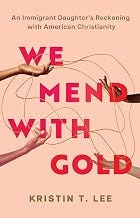
In the introduction to Live Laugh Love, I write that although it is a book that focuses on products made by and for white Christian women in particular, the story also includes women of color—and often women of color are able to see things that white women immersed in the culture are unable to see. As a child, Lee learned that “being a Christian has nothing to do with being Chinese American.” The book traces the evolution of her faith, examining “how immigrant churches often assimilate to Western theology, even as they offer crucial spaces of belonging…Drawing on Black, Asian, and other minoritized theologians, Lee separates the theology of empire from what Jesus preached and lived. Writing of the fractures in our families, churches, and the world, Lee relies on the Japanese art of kintsugi to describe the resplendence of a faith that repairs but doesn’t paper over.”
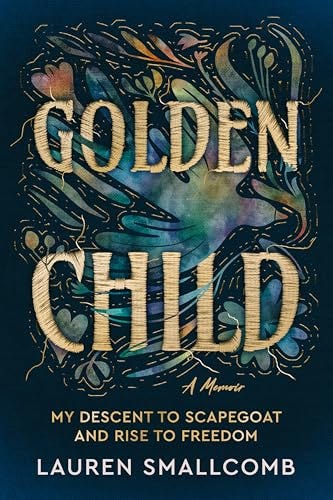
At the heart of Live Laugh Love is an exploration of the power dynamics at the heart of evangelicalism—the use of things like confession and shame to secure loyalty, and the shunning and marginalization of those deemed disloyal to the system. As I’ve studied these dynamics historically, I’ve paid attention to the use of scapegoats to secure conformity, offer emotional catharsis, and build a reactionary political movement. For all these reasons, I’m eager to read Smallcomb’s reflections on the subject in Golden Child.
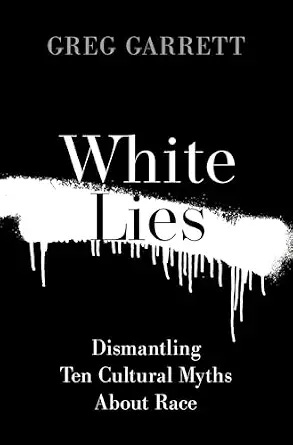
Two other timely books are Greg Garrett’s just-released White Lies: Dismantling Ten Cultural Myths About Race. Greg is a Baylor University professor and a remarkably prolific writer who manages to write nonfiction and fiction while stirring up controversy on a regular basis for such things as teaching a class on Harry Potter and advocating for LGBTQ inclusion.
You can catch an interview with Greg on Faithful Politics Podcast here:
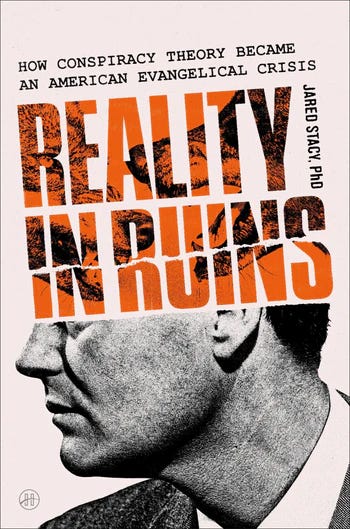
Jared Stacy also has a new book out on evangelicalism and conspiracy theories, Reality in Ruins. For years, evangelical leaders have themselves been identifying this problem—the appeal of conspiracy theories to evangelicals—and surveys back this up. Stacy wants both to explain the problem and empower Christians to resist the allure. As Stacy points out, conspiracy theories aren’t just behind our political dumpster fire today, but “suspicion has fractured families, communities, churches, and our very social fabric, as one person’s fact is another’s fake news.” I think many readers will attest to the corrosive effects of disinformation on personal relationships, and there may be comfort in understanding the process behind this disconnect.
Finally, two books on spirituality offer a constructive counterpoint to some of the more critical studies. (As a historian, I tend to write in the more critical genre, but as a reader, I’m also drawn to those drawing on theology and Christian history to offer more compelling alternatives to abusive and manipulative theologies driving much of our social and political division.)
The first is Tish Harrison Warren’s What Grows in Weary Lands: On Christian Resilience.
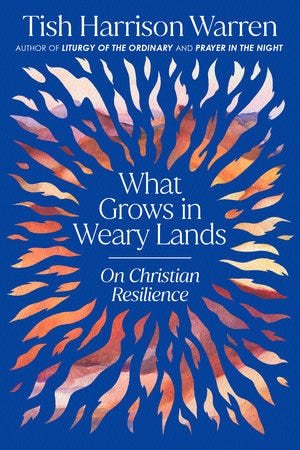
“Early Christians often grappled with a reality we rarely talk about in contemporary life: that God seems to abandon the soul at times, leaving us feeling as if we are alone and left to our own resources. These are times of futility, when work and relationships feel hard, when prayer feels unsatisfying, and we question whether our efforts are amounting to anything.
For centuries, Warren notes, times of “aridity” were seen as necessary prerequisites for growth and maturity. Yet in our culture fixated on speed and optimization, we risk losing this deeper sense of the human journey and the resilience that comes with it.”
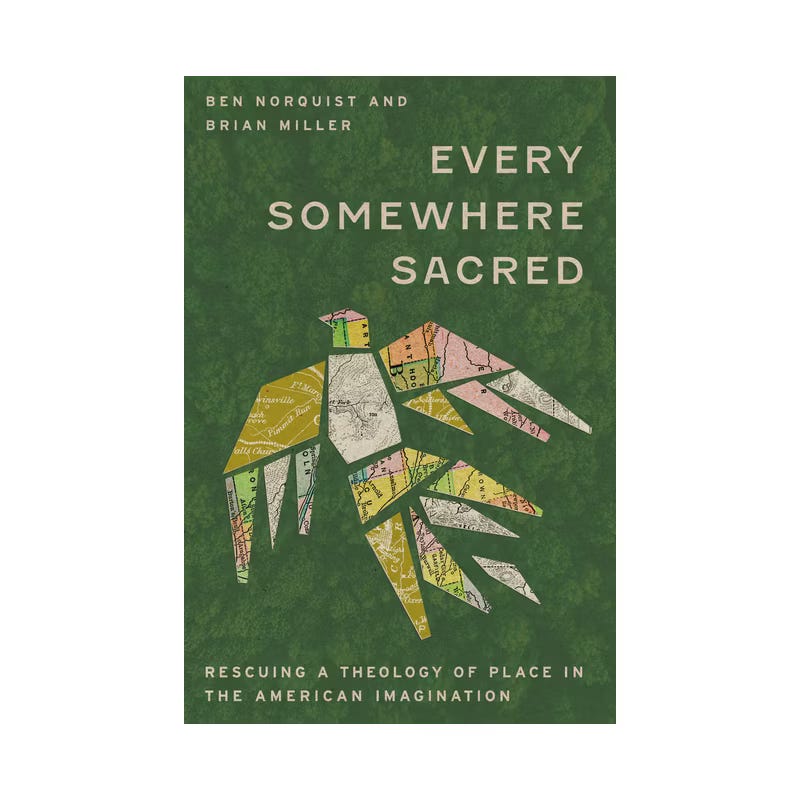
Finally, Ben Norquist and Brian Miller have a new book out on the theology of place, Every Somewhere Sacred. In an age of social media and AI and virtual everything, this book offers a much-needed intervention:
“It’s possible for American Christians to live everywhere and nowhere at the same time. We’re often disconnected from the places we inhabit―cut off from nature, our neighbors, people different from us, and a sense of rootedness. It’s time to imagine a better way….Drawing on social science research and their experiences across American landscapes and the Middle East, Ben Norquist and Brian Miller show how Christians in the US can develop a redemptive imagination for place. Many people have uncritically accepted American cultural assumptions about land, property, home ownership, and the good life. Yet our identity as followers of Jesus should transform how we live in the physical world, even as we recognize how places shape their inhabitants.”
On a whim, I also picked up a copy of Rebecca Donner’s award-winning All the Frequent Troubles of Our Days. Here’s a synopsis:
“Born and raised in Milwaukee, Mildred Harnack was twenty-six when she enrolled in a PhD program in Germany and witnessed the meteoric rise of the Nazi party. As early as 1932, she began holding secret meetings in her apartment—a small band of political activists that by 1940 had grown into the largest underground resistance group in Berlin. She recruited working-class Germans into the resistance, helped Jews escape, plotted acts of sabotage, and collaborated in writing leaflets that denounced Hitler’s regime. Her coconspirators circulated through Berlin under the cover of night, slipping the leaflets into mailboxes, public restrooms, phone booths. When the first shots of the Second World War were fired she became a spy, couriering top-secret intelligence to the Allies. On the eve of her escape to Sweden, she was ambushed by the Gestapo. At a Nazi military court, a panel of five judges sentenced her to six years at a prison camp, but Hitler overruled the decision and ordered her execution. On February 16, 1943, she was strapped to a guillotine and beheaded.
Historians identify Mildred Harnack as the only American in the leadership of the German resistance, yet her remarkable story has remained almost unknown until now.”
Donner is Harnack’s great-grand niece, and she draws on archival materials in Germany, Russia, England, and the US, and her family archive. Reviewers call the book “astonishing…a real-life thriller,” “a stunning literary achievement…a page-turner story of espionage, love and betrayal,” “at once deeply personal and broadly inspiring.”
Usually whenever I publish one of these book posts, I immediately think of several other books that should be on the list as well—so don’t be surprised if there’s a follow-up post. And please share in the comments your own summer reads!
**Whenever possible I’ve linked to Bookshop (where I have a personal store front), but it’s always best to purchase from your favorite local bookstore.
Sorry, I couldn't read past jalapeno limeade. 😂 Is this a mix!? You make it yourself? K, now going back to finish the article.
As if I didn't already have a stack of "to-be-read" books ... Still ... thanks.