
Running Interference
Nonresistance to small things leads to nonresistance to deadlier things

“Ordinary people…cannot be expected to tolerate activities which outrage the ordinary sense of ordinary decency unless the victims are, in advance, successfully stigmatized as enemies of the people, of the nation, the race, the religion. Or, if they are not enemies (that comes later), they must be an element within the community somehow extrinsic to the common bond…” (55).
These words appear in the book They Thought They Were Free: The Germans, 1933-45. The author, Milton Mayer—an American Jew of German descent—interviewed ten ordinary Germans after the Second World War to gain insights into how regular people aided and abetted genocide perpetrated against their neighbors. It’s a chilling read.
Mayer goes on:
“So, in the body politic as in the body personal, nonresistance to the milder indulgences paves the way for nonresistance to the deadlier…”
“It is actual resistance which worries tyrants, not lack of the few hands required to do the dark work of tyranny. What the Nazis had to gauge was the point at which atrocity would awaken the community to the consciousness of its moral habits. This point may be moved forward as the national emergency, or cold war, is moved forward, and still further forward in hot war. But it remains the point which the tyrant must always approach and never pass. If his calculation is too far behind the people’s temper, he faces a palace Putsch; if it is too far ahead, a popular revolution” (56).
“…The German community…had nothing to do except not to interfere. Absolutely nothing was expected of them except to go on as they had, paying their taxes, reading their local paper, and listening to the radio” (57).
“…The fact is, I think, that my friends really didn’t know. They didn’t know because they didn’t want to know; but they didn’t know. They could have found out, at that time, only if they had wanted to very badly. Who wanted to?…Who but an ardent Christian, of the sort that takes Matthew 5 seriously, would undertake the risk of inquiring; who, if injustice were to be discovered by inquiry, would undertake the penalty of protesting? I am sorry to say that none of my friends was that ardent a Christian” (126-27).
When my students read these words this week, many drew direct connections to their own lives—specifically, to their own acknowledged inactivity with respect to the actions of Border Patrol and ICE, to the building of detainment camps, to the deportations and disappearances.
I think many of us can relate. Our lives are busy enough as it is. It’s all so complicated. Do we even know what is happening, or what will happen next? It really doesn’t affect us, after all. Besides, what can any one of us do?
But history teaches us that accommodating smaller injustices leads to accommodating bigger injustices—atrocities, even.
With this warning in mind, I want to share with you two opportunities to cultivate your ability to see, making it more difficult to look away, to not notice, to not interfere.
The first is a wonderful new documentary short (around 30 minutes) produced by Jemar Tisby, Jesus Was a Migrant.
Jemar asks:
If Jesus was a migrant, why are so many of his followers celebrating turning them away?
What is the Christian responsibility toward the stranger and the foreigner?
What is currently happening to the people stranded at the U.S.-Mexico border?
I was with Jemar a couple of weeks ago in Washington DC, where I was able to participate in an advanced screening. It is a beautiful and compelling film.
See for yourself:
If you are in the LA area, Jemar would love to invite you to attend the first public screening. There will be music, food, a panel conversation about the film, and information on how to support immigrants.
April 9 at 8 pm PT @ Lumiere Theater in Los Angeles
Get your tickets HERE.
If you’re not in the LA area, have no fear. This film was designed to be viewed in community—in your community. You can bring this conversation to your church, campus, or community.
As Jemar attests, if we want a different story to spread, we have to carry it ourselves. It’s also a great way to bring members of your community together with those in the community already working with immigrants.
Also, please share the trailer on your own social media to help spread the word.
*************
Another good friend of mine, Melissa Borja, also has a new project out. Melissa is the author of the beautiful (and award-winning) book, Follow the New Way: American Refugee Resettlement Policy and Hmong Religious Change. I had the honor of endorsing that book a couple years back, and here’s what I had to say about it: “A fascinating, deeply perceptive, and highly readable study of the Hmong experience in America. Borja’s pathbreaking book will appeal to a broad readership in religion and cultural studies, refugee resettlement and humanitarian aid, and church-state relations, as well as to the Hmong community itself. An exemplary model of careful scholarship with far-reaching significance.”
She has just released a brand-new podcast, “One Million Neighbors.”
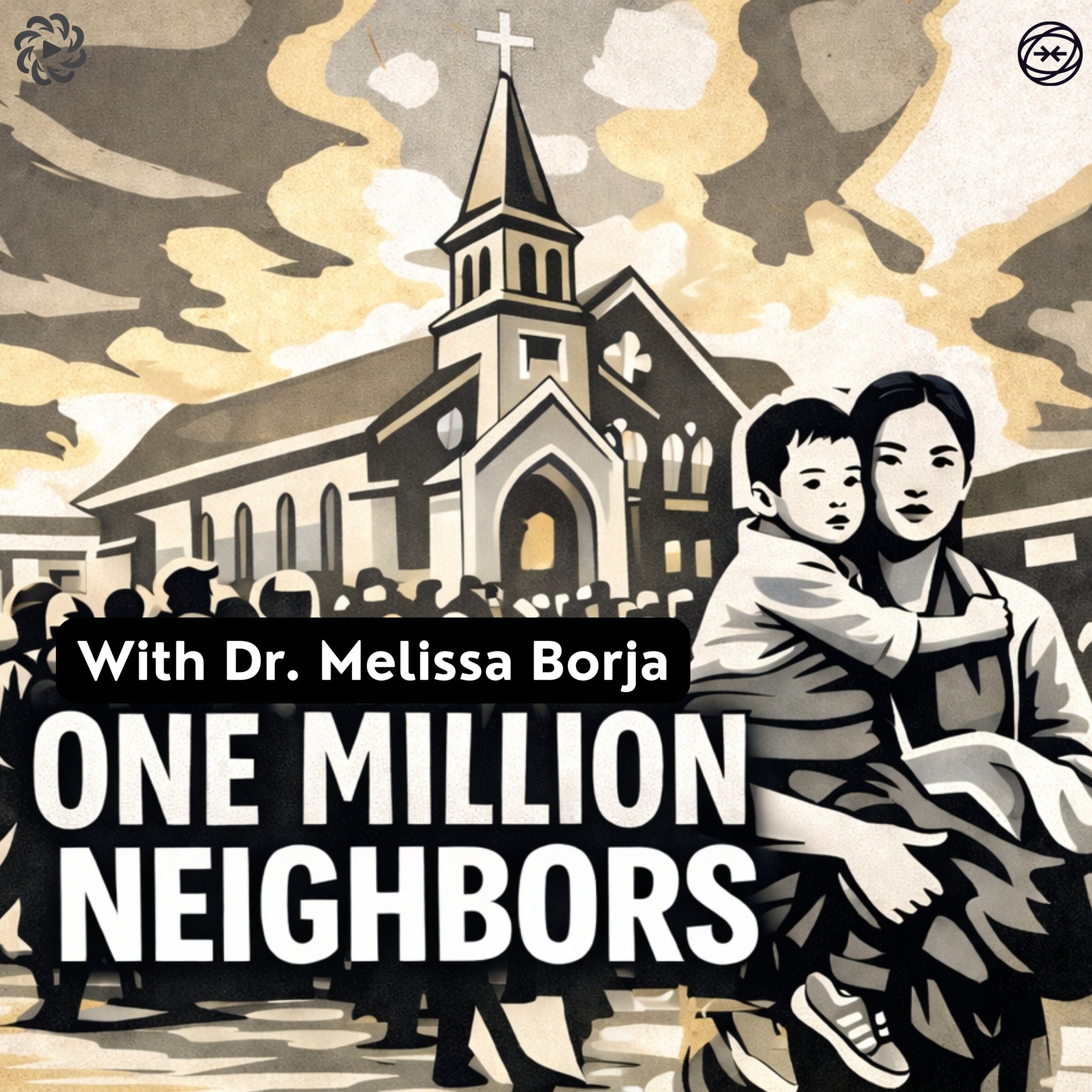
Here’s Melissa’s description of the project:
“One Million Neighbors,” a limited podcast series that tells the powerful story of how faith communities across the United States mobilized to do what many thought was impossible—resettling more than one million Southeast Asian refugees in the face of widespread hostility toward migrants. This story is centered in the Twin Cities, so in many ways it’s the pre-history to the inspiring and robust forms of resistance we’ve witnessed there over the last three months. It draws on research that I share in my book, Follow the New Way, as well as new research about the experiences of Southeast Asian refugees and the people of faith involved in resettlement.
I can’t imagine a more important time to share this story. At a moment when conversations about immigration are often defined by fear and division, this series offers a different narrative—one grounded in solidarity, courage, and collective action.
With Bradley Onishi and the team at Axis Mundi Media, I’m so proud to have created something that showcases the courage, resilience, and love that both the refugees and their sponsors demonstrated throughout the process.
I hope that you’ll give the show a listen and a follow! It would mean a great deal if you could help us spread the word. A post on social media, a mention in a newsletter, or sharing with your professional networks would go a long way in helping this story reach a wider audience.
Finally, I created this show in 2025, as our nation took a horrifying turn in how it treats immigrants, refugees, and asylum-seekers. It has been a dark time, but I believe that, through stories, we can change hearts and minds. To that end, this podcast is designed to be useful for teaching, whether it’s in a K-12 classroom, a university classroom, or a Sunday school classroom. We’ll be sharing supplementary educational materials soon. I’m also happy to do media appearances and guest speaking on this topic, which is very close to my heart.
(You can contact Melissa here.)
There’s plenty of talk these days about what Christians are doing wrong, and rightly so. Melissa’s podcast provides an inspirational—and convicting—counterpoint: There was a time when many American Christians stood against bigotry and worked on behalf of refugees and immigrants. I know; my own community and church denomination were part of this movement.
We know that mass violence happens when people learn to dehumanize “the other,” and when good people decide they can’t be bothered to do anything. There may be a time when it is dangerous to resist, but right now it isn’t. Instead, it is the perfect time to educate yourself and run interference on behalf of those targeted.
******
On this Easter weekend, I also wanted to share with you a post on Easter Vigil—my favorite day of the liturgical year. The darkness feels overwhelming, but there is the tiniest glimmer of dawn breaking through. We know that daylight is coming. But not yet.

This is chilling: “…The German community…had nothing to do except not to interfere. Absolutely nothing was expected of them except to go on as they had, paying their taxes, reading their local paper, and listening to the radio”
We sponsored several Hmong families through our Saginaw churches. An anecdote about getting to know each other and the trauma refugees bring with them- At a fun gathering in the basement of the church kids played hide and seek together as kids do. But when it was time to finish no one could find the Hmong kids. When they were found it was explained that hide and seek wasn’t a game. When their parents told to hide, they did, and they remained hidden until their parents came to get them, so they would not be found by the soldiers and killed.
This is why we must remain a nation that continues to welcome refugees and immigrants.