
Reading for Resistance
A reading list, and something better

In yesterday’s post, I mentioned I’d be back in the classroom this week teaching an Honors course, “Reading for Resistance.”
Essentially, I designed the course around all the things I’ve been wanting to read or re-read. Or, rather, some of the things. I had a hard time narrowing down my choices.
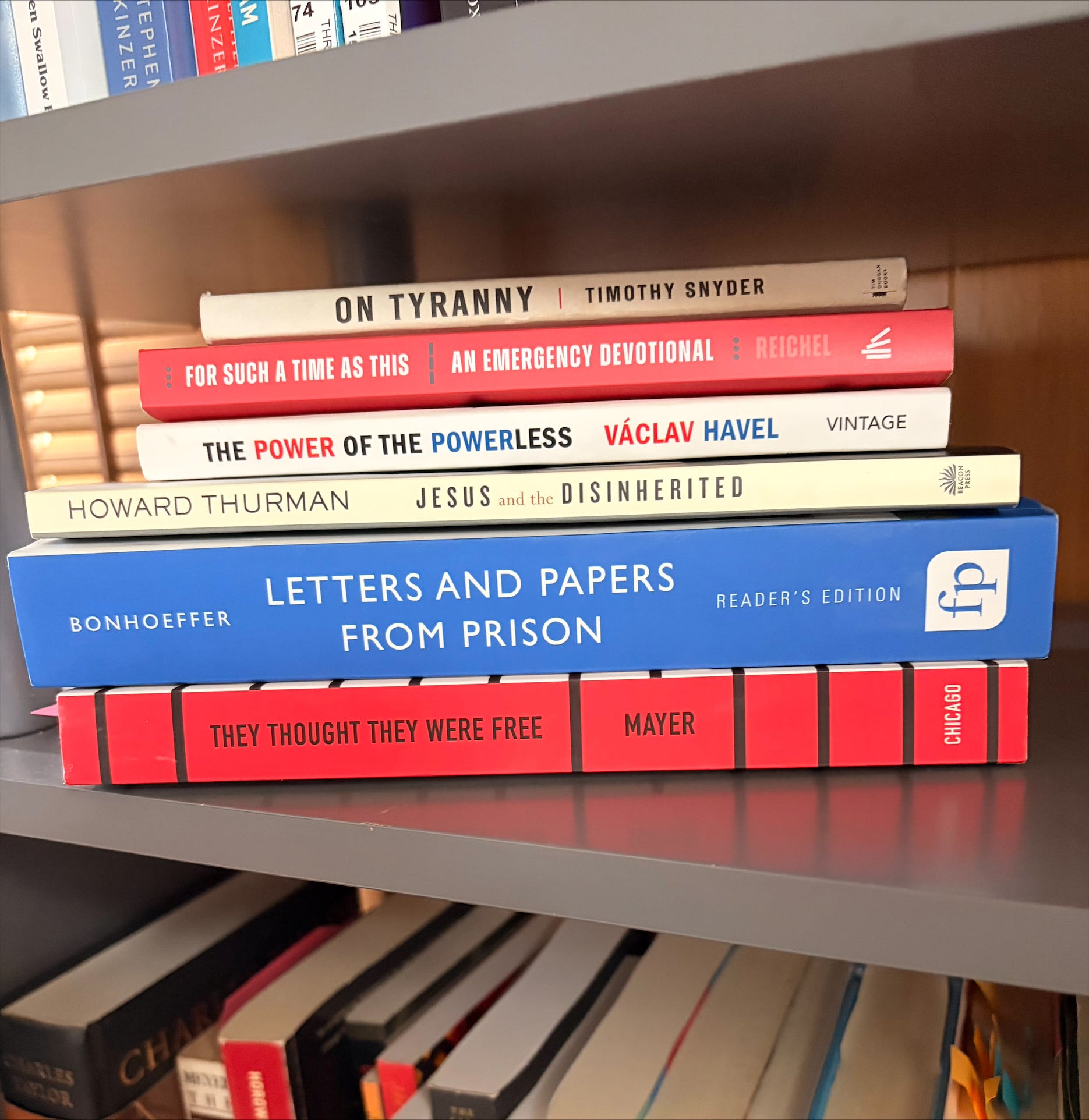
Here’s the book list:
Timothy Snyder, On Tyranny: Twenty Lessons from the Twentieth Century
Milton Mayer, They Thought They Were Free: The Germans, 1933-45
Dietrich Bonhoeffer, Letters and Papers from Prison
Howard Thurman, Jesus and the Disinherited
Vaclav Havel, The Power of the Powerless
Hanna Reichel, For Such a Time as This
I’m also assigning a few articles—mostly primary sources by people like Reinhold Niebuhr and a smattering of secondary sources such as one on the East German Stasi.
For Thursday, we’re staring with On Tyranny.
I have an even better idea, though. If the idea of taking a class sounds fun, we have two courses about to start at the Institute for Christian Studies.
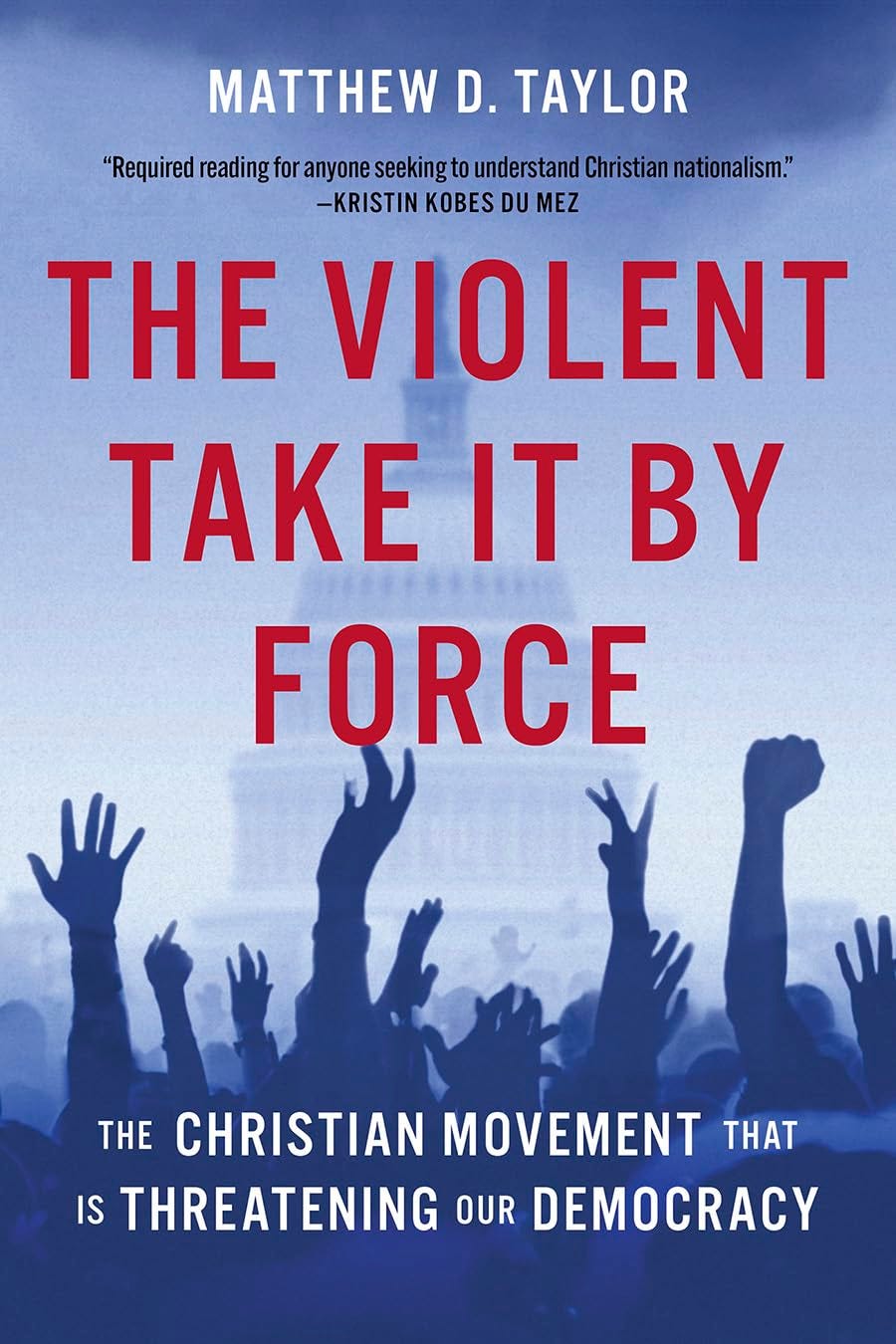
The first starts this week Wednesday, but you still have time to sign up. It is by award-winning scholar Matthew Taylor. You may be familiar with him from his book The Violent Take It by Force, an essential guide to the New Apostolic Reformation and charismatic revival movement. You may have heard him on his fabulous podcast, Charismatic Revival Fury: The New Apostolic Reformation. He holds a PhD in religious studies and Muslim-Christian relations from Georgetown University and an MA in theology from Fuller Theological Seminary. He has held faculty appointments at Georgetown University and George Washington University, and served as a Senior Scholar at the Institute for Islamic, Christian, and Jewish Studies in Baltimore.
Now, he’s offering an online course through the Institute for Christian Studies:
THE CHRISTIAN-JEWISH QUESTION TODAY: ANTISEMITISM, CHRISTIAN ZIONISM, AND ISRAEL
Christianity and Judaism have been entangled in a complex and often painful
relationship since the earliest days of the church. Today, rising antisemitism
within some Christian communities collides with the political theology of
Christian Zionism and debates over Christian support for the modern state of
Israel. This course situates these tensions in historical and theological
context, examining how Christians have understood Jews and Judaism across
time—and how contemporary conflicts echo older patterns. We will also
explore the possibilities and obstacles for Jewish-Christian dialogue in the
present moment.
The course meets weekly on Wednesdays (6:30pm ET) starting March 18. Tuition is $400 CAD, but you can also take the course for credit for $1500 CAD. (The fees cover the cost of the courses; if money is a barrier for you, know that we are working to secure funding for scholarships for future courses—we’re just not there yet!)
And, back by popular demand, Karen Swallow Prior is teaching another course for ICS:
THE EVANGELICAL IMAGINATION: HOW STORIES, IMAGES, AND METAPHORS CREATED A CRISIS
This course will be centered on the book, The Evangelical Imagination: How
Stories, Images, and Metaphors Created a Culture in Crisis by Karen
Swallow Prior. Readings and discussions will cover Charles Taylor’s
definition of social imaginaries and explore central elements of the
evangelical social imaginary, including awakening, conversion, testimony,
improvement, sentimentality, and empire. As part of these explorations, the
course will consider the metaphorical nature of language, along with the
power and limitations metaphors have to communicate truth.
Karen’s course starts March 19 and meets Thursdays at 6:30pm ET.

Both of these courses are taught by instructors who are at the top of their fields—they are the leading experts in these areas, and they are both dynamic teachers. But the classes entail much more than the content you’ll encounter—at a most basic level, they are about community. These aren’t pre-packaged, asynchronous courses. These are weekly conversations where you’ll meet Karen and Matthew and other smart, curious, and interesting people.
Karen taught for ICS last fall, and her students were effusive—not just about Karen, and not just about the course material, but about the community they developed over the course of the class. So, if you wanted a more structured (but still relaxed) learning experience, each of these offers an excellent opportunity.
These are 10/10
Kristin, I am so grateful to have found you and because of finding you I have gone on to learn of so many other faithful Christ-following professionals writing about issues pertinent to the time we are in. I have a number of books mostly in Audible and have begun some of them…I have passed this email/Substack onto the adults of my 11 children and their spouses…I pray they can, like myself, undo/unlearn what I taught them as I homeschooled them in fundamentalism. Jesus and John Wayne described my world; I was beginning to put my finger on “how did I get caught into this iteration of ‘Christianity’?” and I stumbled upon that book. Just thank you, over and over again, for being faithful to Christ and speaking on all that you do. I know there are other sources out there to keep abreast of things, but you just keep seeming to be the main thermometer I go to. Your work, your efforts, your are important to this sister!